
As an Amazon Associate I earn from qualifying purchases.
A Dutch oven is the one pan that makes a kitchen feel like it belongs to someone who cooks. It is also the piece people agonise over longest, because the price range runs from under a hundred dollars to well over four hundred for pots that, from across a room, look identical.
They are not identical. But the differences are narrower than the price gap suggests, and they sit in three specific places: the shape, the interior enamel, and the thickness of the glaze at the rim. Everything else — the badge, the colour name, the country stamped on the base — is taste and marketing.
How to choose, in about ninety seconds
Shape decides more than brand. A round pot suits stews, beans and no-knead bread. An oval suits roasts, whole birds and long cuts. A braiser — wide and shallow — is the shape most people should actually buy: it sears a full batch of chicken thighs without crowding, and reduces a sauce instead of steaming it.
Interior colour is a working decision. Pale sand interiors, like Le Creuset's, let you read the colour of your fond so you know exactly when to deglaze. Matte black interiors, like Staub's, hide stains and build a slightly better crust, but you're browning by smell and instinct rather than sight.
Size: buy smaller than you think. Five to six quarts covers most households. Seven quarts is for Sunday batch cooking and is genuinely heavy when loaded. Four quarts gets used far more often than anyone expects, because you can lift it with one hand.
The honest price answer: a Lodge or Crock-Pot Artisan will braise as well as a Le Creuset. What the French pots buy you is thicker enamel that resists chipping for decades, tighter quality control, and a resale value that is genuinely non-zero. If you cook three times a week, the budget pot is the correct choice. If you cook daily and plan to keep it twenty years, the expensive one stops looking expensive somewhere around year six.
The 17 picks

Le Creuset Signature Oval Dutch Oven, 6.75 qt.
The oval shape is the one people underestimate. A whole chicken fits, a bone-in pork shoulder fits, a loaf of no-knead bread fits with room to spring. Le Creuset's sand-coloured interior enamel shows you exactly how dark your fond is getting, which is the entire reason people who cook seriously refuse to switch to black interiors. Heavy, yes — 13 pounds empty. That weight is the thermal mass doing the work.
Check Price on Amazon
Le Creuset Signature Braiser, 3.5 qt., Sea Salt
A braiser is a Dutch oven that got wider and shorter, and for most weeknight cooking it's the better shape. More surface area means a real sear on eight chicken thighs at once instead of two batches. The low domed lid keeps the liquid shallow so sauces reduce instead of steaming. If you're buying one piece of enamelled cast iron and you don't bake bread, buy this shape, not the round pot.
Check Price on Amazon
Le Creuset Signature Braiser, 3.5 qt., Deep Teal
Identical pan to the Sea Salt above — the difference is entirely the glaze, and glaze is why these end up on open shelving instead of in cupboards. Deep Teal is one of the darker gradient enamels: nearly black at the rim, resolving to a saturated blue-green at the base. It photographs far better than it does on a white product background, which is worth knowing before you rule it out.
Check Price on Amazon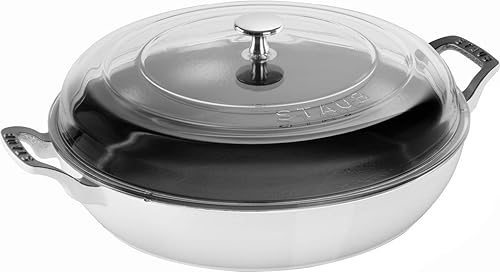
Staub Cast Iron Braiser with Glass Lid, 3.5 qt.
Staub's black matte interior enamel is textured rather than glassy, which grips food slightly and builds a better crust than a smooth interior does. The glass lid is the unusual part — you get Staub's thermal behaviour with the ability to watch a braise without lifting anything and dumping the accumulated steam. Made in France, and the enamel is noticeably thicker than budget brands at the rim, where chips normally start.
Check Price on Amazon
Staub Braiser, 26 cm, Black
26 cm across is the size where a braiser stops being a small-batch pan. Two handles rather than one long handle, so it goes oven to table without a trivet dance. The self-basting spikes on the underside of the lid are not marketing — condensation collects on them and falls back over the food rather than running down the walls, which is why Staub braises come out less dry than the same recipe in a smooth-lidded pot.
Check Price on Amazon
Staub Braiser, 24 cm, Cherry
The 24 cm is the two-to-three person size and the one that actually fits in a small oven alongside something else. Cherry is Staub's deep gradient red — considerably darker and less orange than Le Creuset's Cerise, if you're trying to match pieces you already own. Induction compatible, like all enamelled cast iron, and it will outlive the hob you buy it for.
Check Price on Amazon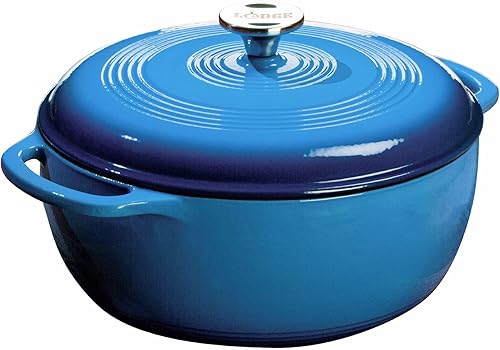
Lodge Essential Enamel Dutch Oven, 6 Qt., Caribbean Blue
Thirty-nine thousand ratings at 4.7 is not an accident. Lodge's enamelled line does the thing that matters — even, slow, retained heat — at roughly a fifth of the French price. The trade-offs are honest: the enamel is thinner, the lid knob is not oven-safe as high, and the finish is glossier and less subtle. For bread baking, stews and everything you'd be nervous about scratching, this is the pot to buy first.
Check Price on Amazon
Lodge Essential Enamel Dutch Oven, 6 Qt., Indigo
Same 6-quart body, same performance, a much quieter colour. Indigo reads almost navy in daylight and near-black under warm kitchen lighting, so it disappears against dark cabinetry instead of shouting. If you want the practical pot but not the statement piece, this is the colourway to pick.
Check Price on Amazon
Lodge Essential Enamel Dutch Oven, 6 Qt., Storm Blue
Storm Blue is the grey-blue that sits between the cream and sage pieces most people already own, which makes it the easiest of the three to build a shelf around. Worth saying plainly: these three Lodge listings are the identical pot. Pick on colour alone and don't pay a premium for whichever one is trending.
Check Price on Amazon
Lodge Enameled Dutch Oven, 6 Qt., Lilac + Care Kit
Enamel stains. Tomato, turmeric and long browning all leave a film that washing-up liquid won't shift, and people assume the pot is ruined when it needs a mild abrasive made for enamel. This listing pairs the Lilac 6-quart with Lodge's care cream, which is the single accessory that keeps a pale interior looking new past year two. Worth it if you're buying a light-coloured pot at all.
Check Price on Amazon
Crock-Pot Artisan 5 Qt. Round Dutch Oven, Red
Nearly five thousand ratings at 4.7 for a pot that regularly sits well under three figures. Five quarts is the sweet spot for two to four people — big enough for a full braise, small enough to actually lift when it's loaded. The enamel is glossy and the red is bright rather than gradient, so it reads cheerful rather than French. Excellent first Dutch oven, and no guilt if it gets knocked about.
Check Price on Amazon
Crock-Pot Artisan 7 Qt. Oval Dutch Oven, Sapphire Blue
Seven quarts, oval, for the people who cook on Sundays for the whole week. This is the capacity where a brisket or a full pot of chilli stops being a squeeze. Understand what you're lifting: a 7-quart enamelled cast iron pot full of liquid is genuinely heavy, so check your oven rack height and your wrists before you size up out of optimism.
Check Price on Amazon
Cuisinart Chef's Classic Enameled Cast Iron Dutch Oven
Cuisinart's enamelled line gets overlooked because the brand is associated with food processors, and that's a mistake. Porcelain-enamelled interior rather than raw or matte black, cast iron body, stainless knob — the specification sheet reads like pots costing three times as much. It's the pick for someone who wants a proper braiser without any of the branding conversation.
Check Price on Amazon
Cuisinart Chef's Classic Enameled Oval Dutch Oven
The oval version, and the one with over five thousand ratings behind it. Oval suits roasts and long cuts; round suits stews and boules. If you already own a round pot in any brand, this is the second shape to add, and at this price it's an easier decision than adding a second French one.
Check Price on Amazon
Martha Stewart Gatwick 4 Qt. Dutch Oven, Navy Blue
Four quarts is the size nobody recommends and everybody ends up using — soup for two, a half batch of ragù, rice for four, a single boule. Light enough to move with one hand, which matters more day to day than any spec on a box. The Gatwick's navy exterior with a pale interior is a straight lift of the classic French look at a fraction of the outlay.
Check Price on Amazon
Overmont Enameled Dutch Oven, 5.5 Qt. + Cookbook & Potholders
Over ten thousand ratings at 4.7, and it arrives with cotton potholders and a recipe book — which sounds like padding until you're holding a 500°F lid. 5.5 quarts is the standard no-knead sourdough size, and the tight lid seal traps enough steam in the first twenty minutes to give a proper oven spring. This is the pot to buy if the reason you want a Dutch oven is bread.
Check Price on Amazon
Nuwave 6 Qt. Cast Iron Dutch Oven, 7-Layer Enamel
Seven enamel layers rather than the usual two or three, which is the specification that determines whether a pot chips at the rim in year three. Newer listing with a smaller review count, so less long-term data than the Lodge — but the build is heavier than the price suggests, and 6 quarts is the do-everything capacity.
Check Price on AmazonCaring for enamel so it lasts
Three rules cover almost everything. Never put a hot pot under a cold tap — thermal shock is what actually cracks enamel, not heavy use. Use wooden or silicone tools on pale interiors; metal leaves grey marks that look like damage but are usually transferred metal. And when the interior stains from tomato or turmeric, use a cream cleanser made for enamel rather than scouring — the stain sits on the glaze, not in it.
Stored properly, none of these pots is a consumable. That is the whole argument for buying one at all.
Pin this guide
- Pin title: 17 Dutch Ovens Worth the Money in 2026
- Hook: Le Creuset vs Lodge — the honest difference
- Description: Seventeen enameled cast iron Dutch ovens and braisers compared on shape, interior enamel and rim thickness — from the $80 pot that braises just as well to the French ones worth keeping for twenty years.